Why Your Swap Fails at the Worst Possible Moment
Jun 4, 2026
What happens when a quote fails to return? You retry. Under normal conditions it arrives and expectations are met, but what if normal changes?
An aggregator’s baseline stability forecasts performance when it’s truly tested. Can you be sure expected performance will hold when conditions deteriorate?
The Black Cloud of Volatility
A quote is the best possible price for a given token pair and trade size. To generate one, an aggregator must:
- Maintain current DEX state
- Compute/optimize routes
- Estimate cost/output
- Return price/execution instructions
Additionally, high-quality quote providers will simulate execution as part of their quote generation, increasing accuracy.
Market volatility stresses each layer simultaneously. The system is trying to compute an optimal route through infrastructure where the state changes faster than can be reliably computed, estimated, and returned.
An aggregator that is shifting to race against state invalidation on top of solving a routing problem is going to have more issues.
Market forces are waves stability rides atop; rising, falling, spiking hardest when demand is high. When choosing an aggregator, inconsistency returning quotes is a disaster waiting to happen: the worst moment to find out your swaps don’t work is when users need it most.
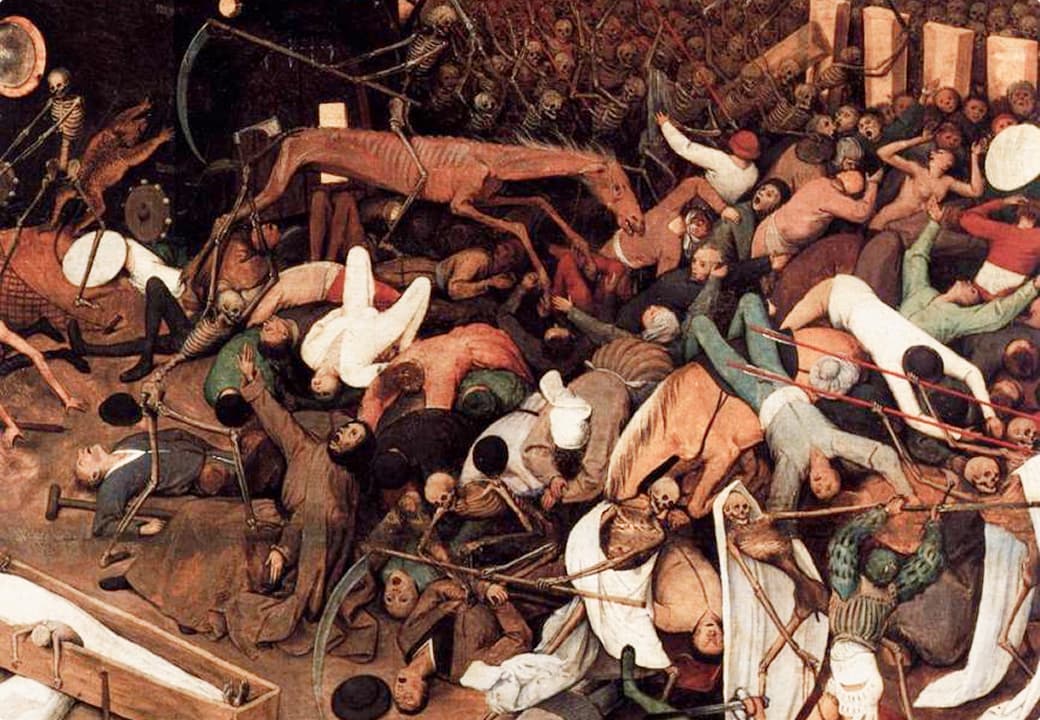
Trade Winds Blowback
Quote failures create materially bad outcomes for users:
- Inability to exit
- Liquidation risk
- Missed market opportunities
- Price erosion (worse after each retry)
In some cases they actually lose money because the system could not handle the load. And nothing will send users into a blind rage more than losing their money.
For integrators, their end users are going to be pissed, likely setting off social repercussions. Crypto users love to surface failures publicly. The backlash is harshest here because they own the relationship.
For aggregators, their integrators are going to be pissed. Wallets and apps may reduce order flow allocation at the very least if not severing ties altogether. Losing a customer due to a lack of stability is bad enough, not to mention the PR tidal wave.
Reliability is stress-tested during volatility. Are quotes failing precisely when users need them most a ticking time bomb you want to be holding?
Fair Weather as a Leading Indicator
If your swap provider’s stability fails during ordinary conditions, that probably tells you something about how it will behave when conditions deteriorate.
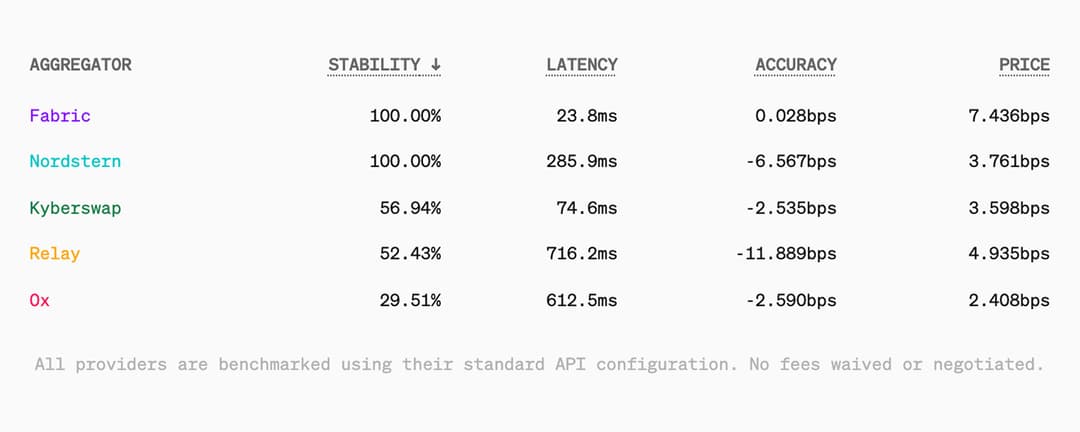
According to Quotebench, Fabric demonstrates a consistently strong stability rate. Now consider an aggregator with a rate of 95%. What seems like a slight performance dip might actually reveal greater fragility. The reality is their infrastructure pipeline is failing to return usable quotes 5% of the time, in fair weather, at low stakes.
To put that into perspective, if your product does $100M in swap volume per month, and your mean txn is $1,000, that’s roughly 5,000 failed swaps every month.
When volatility hits, all the king’s horses and all the king’s men are stress-tested at scale. An aggregator with less stability in calm markets has no buffer. Are we to assume that a 5% gap in stability isn’t likely to change during a storm?
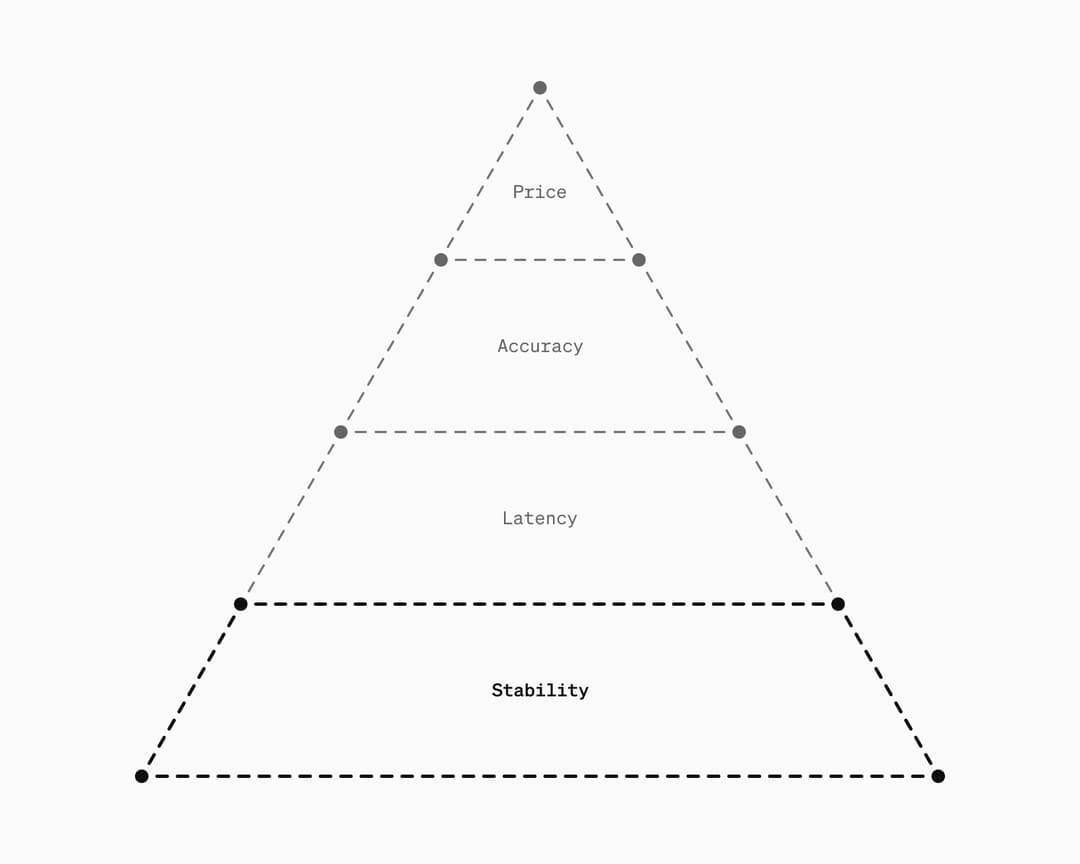
Truth is, an aggregator who wins on price, but inconsistently returns a quote is tuned for a metric that’s lowest in the hierarchy. It is neglecting the first order that determines if a product even works when it counts.
Why Stability Comes First
Stability is foundational to the SLAP framework, Fabric’s methodology for evaluating DEX aggregator performance. It is the first dimension: the percentage of requests that return a usable, executable quote.
The ordering is a hierarchy of needs. Latency, Accuracy, and Price are all meaningful dimensions of performance, but each assumes that a quote exists:
- A fast quote that fails isn’t fast.
- An accurate quote that fails isn’t accurate.
- A competitive quote that fails isn’t a good price.
Stability is the precondition for everything else, which is why it’s the bedrock of the framework instead of being folded into a score allowing a strong price metric to obscure weak reliability.
Most aggregator evaluations are backwards. They start and end at price. But price assumes a trade executes. Under volatility, that assumption is doing a lot of work.
Fabric operates the Fabric Aggregator and spanDEX, an open-source meta-aggregator library. Quotebench, Fabric’s public benchmarking tool, tracks aggregator performance across Stability, Latency, Accuracy, and Price, continuously, in real time.